
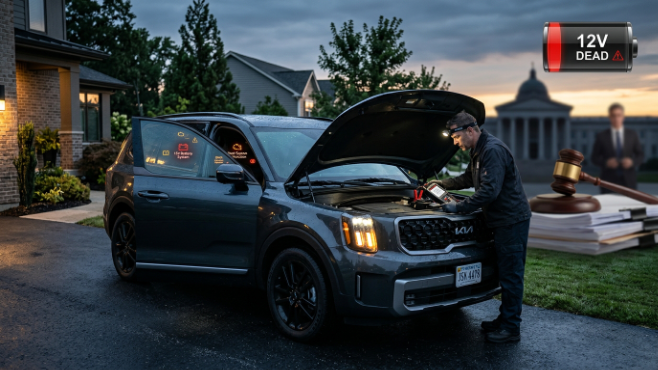
Kia Telluride Battery Drain Lawsuit (2026): Full Case Details, Symptoms, Eligibility & Latest Updates
Last updated: July 3, 2026
Quick Answer
A proposed class action lawsuit filed in June 2026 alleges that Kia America, Inc. sold 2020 through 2026 Kia Telluride SUVs with a defective electrical system that allows the vehicle’s 12-volt battery to discharge while the SUV is parked and turned off. According to the complaint, an electronic control module does not properly enter sleep mode, creating a continuous parasitic battery drain that can leave owners with a dead battery after only one or two days of inactivity.
Owners have reported repeated jump starts, unexpected battery failures, flickering lights, blank dashboard displays, and multiple battery replacements that allegedly fail to solve the underlying problem. The lawsuit is in its earliest stage. No court has certified the proposed class, no settlement has been reached, and no claim form is available at this time.
Quick Facts
| Case Name | Brenman v. Kia America, Inc. |
|---|---|
| Defendant | Kia America, Inc. |
| Court | U.S. District Court for the Central District of California |
| Case Number | 8:26-cv-01428 |
| Filed | June 3, 2026 |
| Vehicles Affected | 2020–2026 Kia Telluride |
| Alleged Defect | Electronic control module and related electrical system allegedly cause parasitic 12-volt battery drain |
| Current Status | Proposed class action pending |
| Settlement | None |
| Recall | None specific to this alleged defect |
| Claim Form | Not available |
The lawsuit remains in its early stages. Because the court has not certified the proposed class, affected owners do not need to register or submit paperwork to preserve potential rights. If the litigation moves forward, any settlement or court-approved notice will explain who qualifies and how claims may be submitted.
What Is the Kia Telluride Battery Drain Lawsuit?
A proposed class action filed in June 2026 accuses Kia America, Inc. of selling certain 2020 through 2026 Kia Telluride SUVs with an undisclosed electrical defect that allegedly causes excessive battery discharge while the vehicle is parked.
According to the complaint, the defect allows electrical components to continue drawing power from the 12-volt battery after the engine has been turned off. This condition is commonly known as parasitic battery drain because electrical current continues flowing even though the vehicle should be in a low-power sleep state.
The plaintiffs argue that owners can unexpectedly return to a vehicle that will not start after sitting overnight or for only a day or two. Many also claim they replaced the battery, only to experience the same problem again because the alleged defect remained within the vehicle’s electrical system rather than the battery itself.
The lawsuit seeks relief on behalf of current and former owners and lessees throughout the United States. At this stage, however, the allegations remain unproven. Kia has not been found liable, and the court has not determined whether the claims have legal merit.
Why Does the Telluride’s Battery Keep Draining?
The complaint attributes the problem to an alleged defect involving the vehicle’s electronic control module, which communicates with multiple electrical systems throughout the SUV.
Modern vehicles rely on dozens of electronic modules that remain active for a short period after the engine is switched off. These systems manage functions such as remote keyless entry, security monitoring, memory settings, infotainment features, and communications between vehicle computers. Under normal operating conditions, these modules gradually enter a low-power sleep mode within a short time after the vehicle is parked.
The lawsuit alleges that one or more electronic modules inside affected Telluride vehicles fail to transition into this sleep mode. Instead, they allegedly continue drawing electrical current from the 12-volt battery, even while the SUV remains parked.
Because this current draw continues around the clock, the battery may lose enough charge to prevent the engine from starting. Owners often report that jump-starting the vehicle temporarily restores operation, but the problem returns after the vehicle sits unused again.
The complaint further alleges that replacing the battery alone may not resolve the issue because the source of the drain allegedly remains within the vehicle’s electrical system.
Although the lawsuit identifies an electronic control module as the source of the defect, these allegations have not yet been proven in court. Future court filings, expert testimony, engineering evidence, and discovery may further clarify the precise cause of the reported battery drain.
Understanding the 12-Volt Battery System
Many drivers assume that once the engine shuts off, the battery stops supplying power. Modern vehicles operate differently.
The 12-volt battery continues providing electricity to essential systems after the engine is turned off. These include the vehicle’s security system, remote locking functions, onboard memory, clock settings, and communications between electronic modules.
A small amount of battery use during this period is completely normal. Engineers refer to this as a parasitic draw, and every vehicle experiences it to some degree.
Problems arise only when the electrical draw exceeds normal levels or continues for an extended period because a control module fails to shut down properly. According to the lawsuit, that is exactly what occurs in certain Kia Telluride vehicles.
If the battery continues supplying power throughout the day and night instead of entering a normal low-power state, its charge may gradually drop below the level needed to start the engine. Owners may then encounter repeated no-start conditions, low-voltage warnings, or other electrical symptoms even if the battery itself is relatively new.
Determining the exact cause of excessive battery drain typically requires diagnostic testing performed by trained technicians. Such testing may include measuring parasitic current draw, evaluating charging-system performance, inspecting electronic modules, and reviewing diagnostic trouble codes stored by the vehicle’s onboard computers.
The outcome of this lawsuit may ultimately depend on whether evidence demonstrates that the reported battery drain results from a common design defect rather than isolated battery failures or normal component wear.
What Symptoms Point to This Defect?
Owners who have reported this issue describe a pattern of electrical problems that often begins with an unexpected dead battery. While a single battery failure can happen for many reasons, the lawsuit alleges that repeated electrical problems across affected Telluride vehicles point to a common underlying defect rather than normal battery wear.
Commonly reported symptoms include:
- A dead battery after the vehicle sits parked overnight or for one to two days.
- Repeated jump starts despite installing a new battery.
- Multiple battery replacements that fail to permanently resolve the problem.
- Flickering headlights, interior lights, or hazard lights.
- A blank or temporarily disabled instrument cluster.
- Warning messages related to the battery or charging system.
- Slow or failed engine starts.
- Stalling at low speeds or while stopped in traffic.
- Loss of power to electronic accessories or infotainment features.
- Electrical systems behaving unpredictably after the battery voltage drops.
Many of these symptoms can also result from unrelated problems, including a weak battery, a failing alternator, loose battery terminals, damaged wiring, or other electrical faults. The lawsuit does not claim that every battery failure in a Kia Telluride results from the alleged defect.
Instead, the plaintiffs argue that affected vehicles share a recurring pattern in which the battery repeatedly loses charge because the electrical system allegedly continues drawing power after the vehicle has been turned off.
Owners who experience several of these symptoms over a relatively short period may wish to document when each incident occurred and what repairs were performed. Detailed records can become important if the litigation progresses or if future warranty questions arise.
What Should Owners Do If They Experience These Symptoms?
The lawsuit remains pending, and no settlement or claims process currently exists. Even so, owners experiencing repeated battery failures may benefit from keeping organized records while the issue is investigated.
Consider documenting:
- Dates when the battery failed.
- Mileage at each incident.
- Photographs of dashboard warning messages.
- Dealer repair orders.
- Diagnostic reports.
- Battery replacement receipts.
- Towing or roadside assistance invoices.
- Communications with dealerships or Kia customer service.
If the vehicle remains under warranty, owners should promptly report recurring battery problems to an authorized Kia dealership. Requesting written diagnostic findings can help establish a repair history if the issue continues.
Drivers should also avoid assuming that installing another battery permanently fixes the underlying problem. According to the allegations in the complaint, the reported battery drain may originate within the vehicle’s electrical system rather than the battery itself.
Owners can also periodically check their Vehicle Identification Number (VIN) through the National Highway Traffic Safety Administration (NHTSA) website for future recalls, investigations, or manufacturer safety campaigns involving their vehicle.
What Did Kia Allegedly Know — and When?
According to the complaint, Kia identified or should have identified the alleged electrical defect before many affected vehicles reached consumers.
The plaintiffs contend that the company had opportunities to detect the issue during vehicle development, validation testing, supplier evaluations, warranty data analysis, dealership repair reports, customer complaints, and post-sale quality monitoring.
The lawsuit further alleges that Kia continued marketing and selling affected Telluride models without adequately warning consumers about the reported battery drain or providing a permanent repair.
The complaint also argues that replacing the battery alone often failed to eliminate the recurring problem because the alleged source of the electrical draw remained unchanged.
The plaintiffs maintain that many owners experienced repeated battery failures despite following normal maintenance schedules and replacing batteries that would ordinarily be expected to last several years.
These allegations remain unproven. They represent the plaintiffs’ position and have not been accepted as fact by the court.
As litigation proceeds, both parties may exchange internal documents, engineering records, testing data, warranty information, and expert opinions through the discovery process. That evidence may ultimately help determine what Kia knew, when it became aware of the reported issue, and whether the company had any legal duty to disclose or correct the alleged defect.
Kia’s Response
As of July 3, 2026, Kia has not publicly responded to the specific allegations contained in this proposed class action lawsuit.
The company has not admitted that the alleged defect exists, accepted responsibility for the reported battery drain, or announced a recall addressing the claims made in the complaint.
Because the litigation has only recently been filed, Kia may still respond through formal court filings rather than public statements. In many automotive class actions, manufacturers first challenge the legal sufficiency of the complaint before addressing the technical allegations in detail.
Readers should therefore distinguish between allegations contained in the lawsuit and findings made by a court. At this stage, the claims remain disputed, and no judge or jury has determined whether Kia is legally liable.
This article will be updated if Kia files an official response, issues a technical service campaign, announces a recall, or provides additional information regarding the reported battery drain.
Timeline of the Lawsuit
Although the litigation is in its earliest stage, the following timeline summarizes the key developments currently known.
| Date | Event |
|---|
| 2019 (alleged) | Plaintiffs allege the defect would have been discoverable during development and validation testing. |
| 2020 | First affected Telluride model year enters production. |
| 2021 onward | Complaint alleges NHTSA complaints and owner reports continued. |
| June 3, 2026, | Brenman v. Kia America, Inc. filed in the Central District of California. |
| Present | Litigation pending. No settlement. No class certification. |
Future milestones may include:
- Kia’s formal response to the complaint.
- Motions filed by either party.
- Exchange of evidence during discovery.
- A court decision on class certification.
- Settlement discussions or trial proceedings, if necessary.
Automotive class actions often take many months or several years to resolve, so owners should not expect immediate updates or compensation while the case moves through the legal process.
Which Kia Telluride Model Years Are Covered?
The complaint identifies 2020 through 2026 Kia Telluride SUVs as the vehicles allegedly affected by the reported battery drain defect.
According to the lawsuit, the proposed class includes current and former owners or lessees of these vehicles throughout the United States, regardless of trim level, provided they meet the class definition ultimately approved by the court.
The proposed model years include:
- 2020 Kia Telluride
- 2021 Kia Telluride
- 2022 Kia Telluride
- 2023 Kia Telluride
- 2024 Kia Telluride
- 2025 Kia Telluride
- 2026 Kia Telluride
Because the court has not yet certified the proposed class, the final definition of eligible vehicles could change as the litigation progresses.
Owners who are unsure whether their SUV falls within the affected model years can confirm the model year and production details using their VIN, vehicle registration documents, or ownership records.
Simply owning one of these vehicles does not automatically establish that the alleged defect is present. The lawsuit claims that the defect affects vehicles across these model years, but the court has not yet determined whether those allegations are supported by the evidence.
Do I Have to Do Anything to Be Included?
No. At this stage, eligible owners and lessees do not need to sign up, register, or submit a claim to preserve their potential rights.
This lawsuit has been filed as a proposed class action, which means the court must first decide whether the case can proceed on behalf of a larger group of vehicle owners. Until the court certifies the proposed class, there is no official claims process or settlement administrator.
If the court later certifies the class and the case results in a settlement or judgment, eligible owners typically receive notice by mail, email, or another court-approved method. Those notices explain who qualifies, what benefits may be available, important deadlines, and whether any action is required.
Owners should be cautious of websites or individuals claiming they can register people for compensation before the court authorizes a claims process. As of July 3, 2026, no legitimate registration portal or claim form exists for this lawsuit.
Is There Money or Compensation Available Right Now?
No.
Because the lawsuit was only recently filed, the court has not awarded damages, approved a settlement, or established a compensation program.
If the plaintiffs ultimately succeed or the parties negotiate a settlement, potential benefits could vary depending on the final agreement. In automotive class actions, settlements sometimes include one or more of the following:
- Reimbursement for qualifying battery replacement expenses.
- Compensation for towing or roadside assistance costs.
- Reimbursement for diagnostic or repair expenses.
- Extended warranty coverage for affected components.
- Software updates or replacement of defective parts.
- Cash payments for eligible owners, where appropriate.
These examples are common forms of relief in vehicle defect litigation. They are not promises of what will occur in this case.
The court has not determined whether Kia is liable, and no settlement discussions have been publicly announced.
Owners should continue saving repair invoices, battery replacement receipts, dealership records, and towing expenses in case those documents become relevant later in the litigation.
What Legal Claims Does the Lawsuit Raise?
Although the case is still in its early stages, automotive defect lawsuits commonly rely on consumer protection and warranty laws when plaintiffs believe a manufacturer sold vehicles with an undisclosed defect.
The specific legal claims asserted in this complaint will ultimately control the litigation, but the lawsuit generally alleges that Kia failed to adequately address or disclose the reported battery drain issue.
Depending on the complaint, claims in automotive class actions often include:
- Breach of express warranty.
- Breach of implied warranty.
- Violation of state consumer protection statutes.
- Fraudulent or negligent omission.
- Unjust enrichment.
- Requests for declaratory or injunctive relief.
Each legal theory has different requirements, and the plaintiffs must present evidence supporting every claim. Kia will have the opportunity to challenge both the factual allegations and the legal claims as the litigation progresses.
At this stage, the court has not ruled on the merits of any claim.
Has Kia Issued a Recall for This?
No.
As of July 3, 2026, Kia has not announced a safety recall specifically addressing the alleged parasitic battery drain defect described in this lawsuit.
A lawsuit and a recall are separate legal processes.
A manufacturer may face civil litigation even when no recall has been issued, and a recall may occur independently of a lawsuit if safety regulators determine that a safety-related defect exists.
Owners can periodically search their Vehicle Identification Number (VIN) through the National Highway Traffic Safety Administration (NHTSA) recall database to determine whether any future recalls, safety investigations, or manufacturer campaigns affect their specific vehicle.
Owners should also ask their dealership whether any Technical Service Bulletins (TSBs) or software updates apply to their Telluride. A TSB differs from a recall because it provides repair guidance to dealerships without requiring every affected vehicle to be repaired free of charge.
As of this publication, no recall has been announced specifically for the battery drain allegations described in this lawsuit.
How This Case Differs From Other Kia Telluride Lawsuits
The Kia Telluride has been the subject of multiple lawsuits involving different alleged defects. Each case focuses on a separate issue, and owners should not assume they involve the same vehicle systems or legal claims.
| Case | Model Years | Primary Alleged Defect | Status |
|---|---|---|---|
| Parasitic Battery Drain (this case) | 2020–2026 | Electronic control module allegedly causes continuous 12-volt battery drain while parked | Newly filed |
| Instrument Cluster Lawsuit | 2023–2025 | Digital instrument cluster allegedly goes blank while driving | Pending |
| Brake Defect Lawsuit | 2020–2024 | Alleged master cylinder and brake pedal defects | Pending |
Although some owners have reported both battery problems and dashboard display issues, the lawsuits involve different alleged defects and separate legal proceedings.
If multiple lawsuits apply to the same model year, eligibility under one case does not automatically determine eligibility under another.
Where Can Owners Report the Problem?
Owners experiencing recurring battery failures may wish to report the issue through official channels while continuing to work with their dealership.
Helpful steps include:
- Report recurring problems to an authorized Kia dealership.
- Keep copies of all repair orders and diagnostic reports.
- Save receipts for batteries, towing services, and repairs.
- File a vehicle safety complaint with the National Highway Traffic Safety Administration (NHTSA) if appropriate.
- Check your VIN periodically for new recalls, investigations, or manufacturer service campaigns.
Reporting a problem does not automatically make someone part of the lawsuit, nor does it guarantee compensation. However, owner complaints may help regulators and manufacturers identify recurring issues across larger groups of vehicles.
If additional recalls, investigations, or manufacturer programs are announced in the future, owners who have maintained complete service records may find it easier to document their repair history.
Also Read: MSG Data Breach Class Action Lawsuit 2026: Latest Updates, Eligibility & Legal Analysis
Frequently Asked Questions
Is my 2022 Kia Telluride included in this lawsuit?
Potentially, yes. The proposed class action covers 2020 through 2026 Kia Telluride vehicles. However, the court has not yet certified the proposed class, so the final class definition could change as the litigation progresses.
My Telluride battery has died several times. Does that mean I qualify?
Repeated battery failures match one of the patterns described in the complaint, but they do not automatically establish eligibility or prove that your vehicle has the alleged defect. If you experience recurring electrical problems, keep repair records, battery replacement receipts, and dealership diagnostic reports while the case moves forward.
Does replacing the battery permanently solve the problem?
According to the lawsuit, many owners allegedly replaced one or more batteries only to experience the same issue again. The plaintiffs argue that the reported problem originates within the vehicle’s electrical system rather than the battery itself. These allegations have not yet been proven in court.
Has Kia recalled the Telluride for this battery drain issue?
No. As of July 3, 2026, Kia has not announced a recall specifically addressing the alleged parasitic battery drain defect described in this lawsuit.
Is there a settlement or claim form available?
No.
The lawsuit was filed on June 3, 2026, and remains in its early stages. No settlement has been reached, no compensation has been approved, and no claim form is currently available.
Do I need to join the lawsuit now?
No.
If the court eventually certifies the proposed class, eligible owners generally become part of the class automatically unless they choose to opt out. At this stage, there is no registration process.
Can I still drive my Kia Telluride?
Many owners continue driving their vehicles. However, if your SUV repeatedly loses battery power, fails to start, or displays warning messages, you should have it inspected by an authorized Kia dealership as soon as possible. Unexpected battery failure can leave a vehicle unable to start when needed.
Will Kia reimburse battery replacements or repair costs?
No reimbursement program has been announced.
If the lawsuit eventually results in a settlement or judgment, any available compensation will depend on the court-approved terms. Until then, owners should keep receipts for batteries, towing, diagnostics, and related repairs.
What is parasitic battery drain?
Parasitic battery drain occurs when a vehicle continues drawing more electrical power than expected after it has been turned off. Every modern vehicle uses a small amount of battery power while parked, but excessive current draw can discharge the battery and prevent the engine from starting.
The lawsuit alleges that certain Telluride vehicles experience abnormal parasitic battery drain because one or more electronic control modules fail to enter a normal low-power sleep mode.
Is this lawsuit the same as the Telluride instrument cluster case?
No.
This lawsuit focuses on an alleged battery drain defect affecting 2020 through 2026 Kia Telluride vehicles.
Another pending lawsuit concerns 2023 through 2025 Telluride models with an allegedly defective digital instrument cluster that can go blank while driving. Although some owners report both issues, the lawsuits involve different alleged defects and separate legal proceedings.
How long could this lawsuit take?
There is no fixed timeline.
Vehicle defect class actions often require many months or several years before reaching class certification, settlement, dismissal, or trial. The pace depends on court schedules, discovery, motions, and negotiations between the parties.
Bottom Line
The proposed class action Brenman v. Kia America, Inc. alleges that 2020 through 2026 Kia Telluride SUVs contain an electrical defect that allows excessive 12-volt battery drain while the vehicle is parked.
According to the complaint, the alleged defect can lead to repeated dead batteries, multiple jump starts, flickering lights, blank instrument clusters, and recurring electrical problems that battery replacement alone may not resolve.
The lawsuit remains in its earliest stages. Kia has not been found liable, the court has not certified the proposed class, and no settlement, recall, or claims process currently exists for the alleged battery drain defect.
Owners experiencing recurring electrical problems should continue documenting repairs, save all service records and receipts, and monitor future developments as the litigation progresses.

Ayesha Awais is a content writer for JudicialNexus.com, covering accident reports, injury-related news, lawsuits, and public safety updates. All content is informational in nature and based on publicly available sources.