
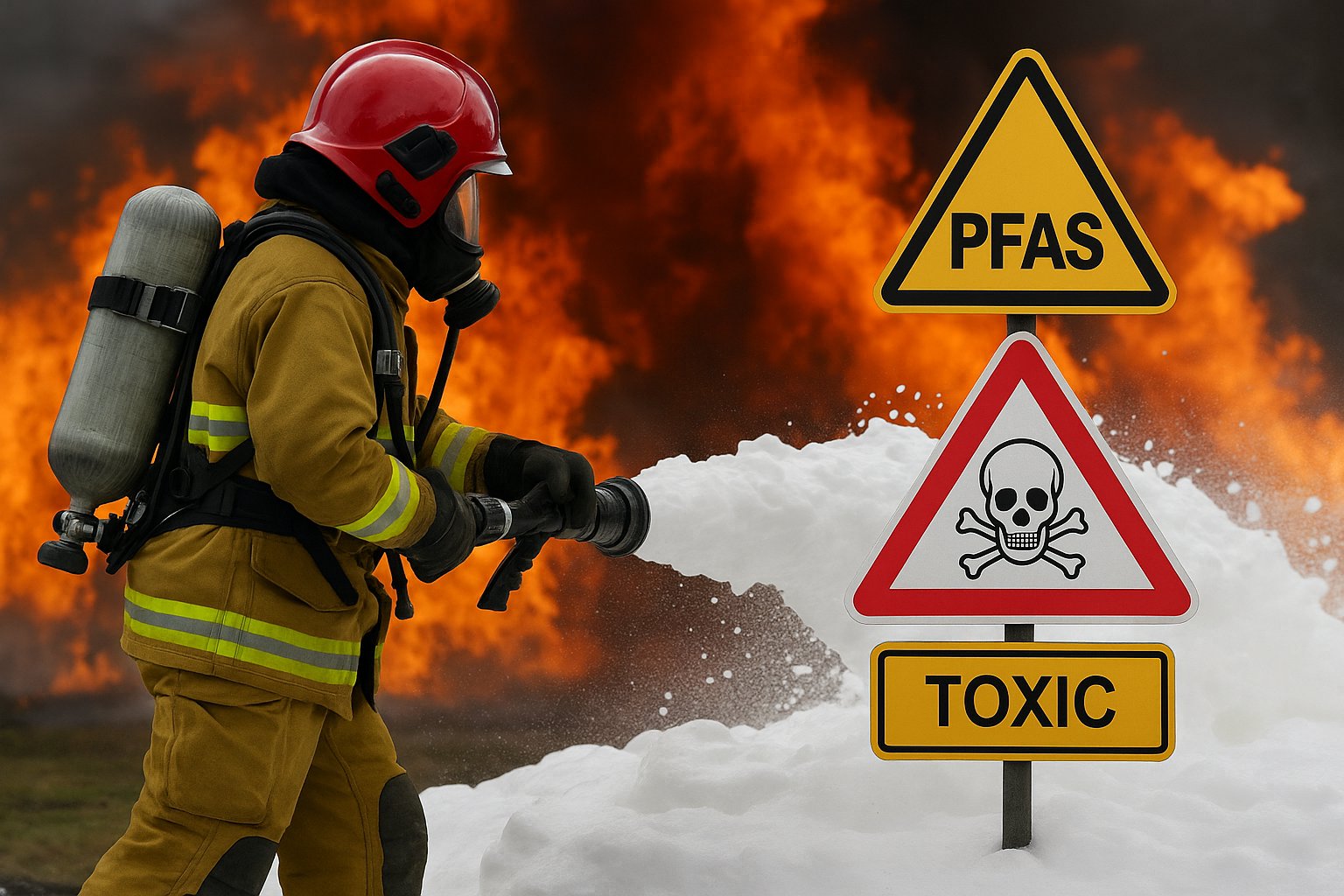
AFFF stands for Aqueous Film-Forming Foam. It is a type of firefighting foam designed to extinguish flammable-liquid fires (such as those caused by jet fuel, gasoline, or chemical solvents). Fire departments, airports, military installations, and industrial facilities have used AFFF for decades.
AFFF often relied on PFAS — a broad class of synthetic chemicals including PFOS, PFOA, and related compounds. PFAS attracted use because they resist heat, water, and oil. However, PFAS are persistent in the environment and the human body. Over time, PFAS can accumulate in water supplies, soil, and tissues. That persistence presents serious concerns for human health and environmental safety. Because many AFFF foams use PFAS, AFFF has become a focus of litigation, regulatory action, and public-health scrutiny.
PFAS & Health Risks: What Research and Authorities Say
Studies and regulatory reviews link PFAS exposure to increased risks of certain health conditions. Among the risks: elevated incidence of kidney and testicular cancers, liver and thyroid disorders, hormonal disruption, immune system effects, and other chronic issues. Given PFAS persistence, even low-level, long-term exposure — via contaminated water, environmental pollution, or repeated occupational handling — may elevate risk.
Where causation remains uncertain, public health authorities often use cautious phrasing, such as “associated with,” “linked to increased risk,” or “may increase the probability of.” That reflects ongoing scientific evaluation. For persons exposed via firefighting foam, contaminated water, or environmental PFAS releases, these established risks form part of the basis for legal claims.
Who Is Suing — And Who Might Qualify
AFFF and PFAS lawsuits involve a wide range of individuals, workers, and organizations affected by contaminated firefighting foam or polluted water sources. These claims continue to grow as more people learn about exposure risks and as testing identifies additional contaminated sites across the United States.
Key groups currently filing claims
Firefighters — civilian and military
Firefighters are among the most affected groups. Many handled AFFF foam repeatedly during training exercises and active fire response. Exposure occurred through direct skin contact, inhalation of foam mist, and contact with contaminated gear. Firefighters who later developed PFAS-linked illnesses, such as kidney cancer or testicular cancer, often qualify for legal action.
Airport rescue and fire-suppression workers
Airport fire crews and ground emergency teams frequently used AFFF for aircraft fuel fires. Because aviation fuel fires require rapid suppression, these workers were exposed more often and in higher concentrations than the general public. Long-term exposure in this environment forms the basis for many claims.
Industrial, oil, and chemical plant workers
Facilities that stored or transported flammable materials often relied on AFFF for fire prevention. Workers in refineries, fuel depots, manufacturing plants, and chemical processing sites may have encountered PFAS-containing foam during routine operations or emergency events.
Military service members and veterans
U.S. military bases have used AFFF for decades in training drills and actual emergencies. Hundreds of bases now show signs of PFAS contamination in their soil and groundwater. Veterans who served at these locations and later developed qualifying illnesses may be eligible to file a claim.
Residents of contaminated communities
People who lived near military bases, airports, refineries, or industrial facilities may have consumed PFAS-contaminated drinking water for years without knowing it. Groundwater and well contamination have denied many families safe drinking water. These residents often become part of community-based or individual lawsuits.
Public water systems, municipalities, and utilities
Cities, towns, and water authorities have filed lawsuits to recover the enormous cost of testing and cleaning drinking water supplies contaminated by PFAS from AFFF use. These cases often target large chemical manufacturers instead of individual facilities.
What Qualifies Someone to File an AFFF or PFAS Lawsuit
Eligibility depends on two main factors: proof of exposure and proof of harm.
Proof of exposure may include
Work history showing regular use or contact with AFFF
Military service records locating you at affected bases
Residential history in towns with documented PFAS contamination
Water test reports confirming contaminated public or well water
Environmental reports linking a location to AFFF or PFAS use
Proof of harm may include
Diagnosis of kidney cancer or testicular cancer
Other medically documented PFAS-linked conditions, such as thyroid disease, liver damage, or immune disorders
Medical records that show the timeline from exposure to diagnosis
Statements from toxicology or medical experts supporting the connection
In many cases, attorneys review exposure history alongside medical data to determine if a claim meets current legal standards under the federal multidistrict litigation process.
When Property Damage or Cleanup Claims Apply
Not all PFAS lawsuits involve personal injury. Some cases focus on environmental and financial damage, including:
Contaminated soil and groundwater
Unsafe drinking water sources
Loss of property value due to pollution
Expensive water filtration and remediation needs
Long-term environmental monitoring requirements
These claims often come from local governments, businesses, and homeowners located near facilities that stored or used AFFF.
What May Affect or Limit Eligibility
Even when exposure exists, some claims may face legal challenges due to:
Lack of clear documentation of exposure
No confirmed medical diagnosis
Multiple possible sources of contamination
Filing outside the allowed legal time window
Incomplete records or weak causation evidence
Courts currently overseeing AFFF litigation have placed greater focus on documented proof and specific disease types. Strong, organized records significantly improve the chances of a successful claim.
Why This Matters Now
Thousands of AFFF-related cases are already part of federal litigation. Courts continue to evaluate evidence for new plaintiffs. As research expands and more contamination sites are identified, new individuals and communities may still qualify to file.
If you suspect exposure, gathering records now and speaking to a qualified attorney can help preserve your legal options before important deadlines pass.
Who’s Being Sued: Companies & Entities Named in AFFF/PFAS Litigation
Defendants in PFAS / AFFF lawsuits often include:
Chemical manufacturers that produced PFAS — e.g., 3M; DuPont and related firms (e.g., Chemours, Corteva) — for supplying PFAS chemicals used in AFFF or other products.
Foam-system manufacturers, distributors, and suppliers who sold AFFF products.
Industrial facilities, airports, military bases, refineries, or other entities that stored, used, disposed of, or otherwise released PFAS/AFFF foams — especially where water supplies or the environment became contaminated.
Because exposure pathways vary (foam use, water contamination, environmental pollution), many lawsuits name a mix of chemical producers, distributors, and property-owners/operators.
The Consolidated MDL & Current Litigation Status (2023–2025)
Many AFFF / PFAS lawsuits have been consolidated under multidistrict litigation: MDL No. 2873, in the U.S. District Court for the District of South Carolina. That structure facilitates coordinated pre-trial proceedings, discovery, settlement negotiations, and case management.
Recent Milestones & Major Settlements
In June 2023, 3M agreed to a nationwide settlement with public water systems for PFAS contamination — valued at up to approximately US$12.5 billion (to compensate drinking-water providers for contamination traced in part to PFAS from AFFF and other PFAS-containing products).
At the same time, in 2023, chemical producers Chemours, DuPont, and Corteva agreed to a US$1.185 billion settlement to resolve PFAS contamination claims filed by U.S. public water systems.
Additional PFAS-related water-system settlement deals have been approved under MDL 2873, covering various companies and utilities.
In May 2025, 3M reached a separate agreement with the State of New Jersey — reportedly US$450 million — to settle PFAS contamination claims tied to certain manufacturing/disposal sites.
In August 2025, Chemours, DuPont, and Corteva agreed to a comprehensive settlement with New Jersey to resolve statewide PFAS-related environmental claims (including legacy contamination and AFFF-linked sites). Reportedly, this covers multiple sites, with structured payments over the years.
What’s Settled — And What’s Still Pending
Most of the big-dollar settlements so far address water-system contamination — that means public water supplies, municipalities, utilities, or statewide environmental claims.
As of 2025, no global settlement has been finalized that resolves all individual personal-injury claims (e.g., cancer or disease claims from PFAS/AFFF exposure in firefighters, workers, or residents).
Litigation continues. Many personal-injury cases remain pending under MDL 2873, and some plaintiff-firms expect bellwether trials in the next 12–24 months.
Health Conditions & Illnesses Alleged in AFFF-PFAS Claims
Claims related to PFAS / AFFF exposure typically involve one or more of the following health problems:
Kidney cancer
Testicular cancer
Liver or thyroid disease
Other cancers or chronic diseases (pending ongoing research)
Organ dysfunction (e.g., liver enzyme disruption)
Hormonal, immune, or metabolic disorders — especially after long-term exposure or contamination (e.g., from water supplies)
Because PFAS accumulate over time, even low-level chronic exposure — through contaminated water, foam residues, or environmental exposure — may raise risk. Plaintiffs generally rely on documented exposure history, medical diagnoses, expert toxicology, and scientific literature linking PFAS to these health outcomes. As medical science evolves, some potential associations remain under study. Courts and regulatory bodies often recognize these associations as “elevated risk” rather than certain causation.
What Compensation Might Look Like — And Why There’s No Guarantee
If a personal-injury claim succeeds (via verdict or settlement), a plaintiff may receive:
Past and future medical costs (treatment, medication, hospital bills)
Compensation for lost wages or loss of earning capacity
Damages for pain, suffering, reduced quality of life, or permanent disability
Possible punitive damages — in cases where companies knowingly expose individuals without proper warning or mitigation
Some legal-profession sources prognosticate that individual PFAS / AFFF claims could yield six-figure settlements (e.g., US$150,000–US$500,000 or more) depending on severity, exposure history, and evidence. However, those estimates are speculative. As of now, no global personal-injury settlement framework has been approved. Outcomes will vary case by case.
What You Should Do If You Think You Were Exposed
If you believe you were exposed to AFFF / PFAS and developed health issues, consider the following steps:
Gather documentation: occupational or service records (e.g., firefighting logs, military duty records, airport or facility employment), water-use history (well records, municipal supply, water-test reports), and any incident reports involving foam usage or chemical spills.
Collect medical records: diagnosis paperwork, lab results, imaging, treatment history — especially for cancers, organ disease, or chronic conditions linked to PFAS.
Consult a qualified attorney or law firm experienced in PFAS / toxic-exposure litigation — ideally one familiar with MDL 2873 and PFAS science.
Act promptly: Statutes of limitation may apply depending on your location, and early documentation helps preserve evidence.
Stay informed: Track major MDL developments, bellwether trials, and settlement announcements; developments may affect eligibility or timing.
Why AFFF / PFAS Litigation Matters in 2025
PFAS contamination — especially due to legacy foam use (AFFF) — remains widespread. Many communities and water supplies still test positive for PFAS.
The 2023–2025 wave of mega-settlements (public-water system cases) highlights recognition of widespread contamination at scale.
Personal-injury litigation has not yet been resolved — but as bellwether trials and discovery advance, courts may begin to issue judgments or authorize wide-scale settlements.
For exposed individuals, documented evidence plus expert-backed medical and toxicology opinions may improve chances of compensation as litigation unfolds.
Because of these developments, 2025 stands as a critical inflection point. For many potential claimants, this may be the best window to act — gather documentation, seek legal advice, and prepare for possible inclusion in settlements or trial-based awards.
Conclusion
AFFF and PFAS exposure have emerged as one of the most consequential environmental-health and mass-tort issues of recent decades. The enormous settlements already achieved underscore how serious PFAS contamination is for public water systems and the environment. Personal-injury claims — for firefighters, veterans, industrial workers, and residents — remain active but unresolved.
If you believe you were exposed through firefighting foam, occupational use, or contaminated water — and you developed serious illness — you should consider gathering documentation and consulting a qualified attorney. The coming months and years may bring significant legal developments and possibly compensation for many affected individuals.

Ayesha Awais is a content writer for JudicialNexus.com, covering accident reports, injury-related news, lawsuits, and public safety updates. All content is informational in nature and based on publicly available sources.