
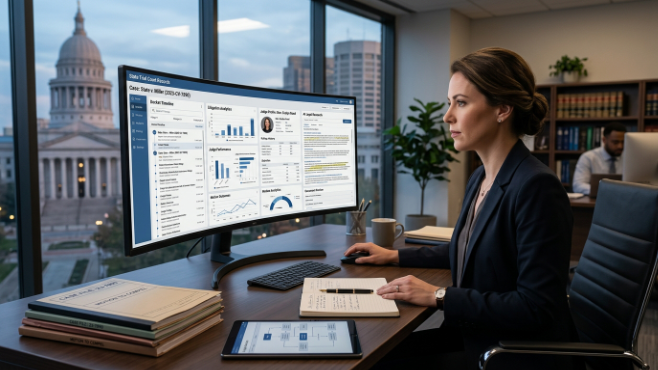
What Is Trellis Law? Complete Review, Features, Pricing & Best Alternatives (2026)
Trellis is an AI-powered legal research and litigation intelligence platform designed to help legal professionals search, analyze, and monitor U.S. state trial court records. Unlike traditional legal research platforms that primarily emphasize appellate opinions, statutes, and secondary legal materials, Trellis focuses on the trial court level, where most civil litigation begins and where many strategic decisions are made.
The platform combines searchable court records with litigation analytics, allowing attorneys to research judges, review prior rulings, monitor case activity, analyze opposing counsel, and identify litigation trends across participating state courts.
For litigators, the value of Trellis extends beyond finding cases. It provides practical insights into how judges have ruled on similar motions, how opposing attorneys have argued comparable issues, and how comparable disputes have progressed through state trial courts.
Quick Answer
What is Trellis Law used for?
Trellis Law is primarily used for:
- Researching state trial court cases.
- Analyzing judges’ historical rulings.
- Monitoring litigation and court dockets.
- Reviewing motions and filings from similar cases.
- Researching opposing counsel.
- Developing litigation strategies using AI-assisted analytics.
It is designed for litigation-focused legal work rather than broad statutory or appellate legal research.
Trellis Law at a Glance
| Category | Details |
|---|---|
| Product Type | AI legal research and litigation analytics platform |
| Primary Focus | State trial court research |
| Best For | Litigation attorneys, solo lawyers, law firms, in-house counsel |
| Key Features | Judge analytics, docket search, AI search, motion analytics, court alerts |
| Deployment | Cloud-based |
| Free Trial | Available periodically |
| Pricing | Tiered subscription with custom enterprise options |
| Main Competitors | Westlaw, LexisNexis, Bloomberg Law, Fastcase |
Company Overview
Trellis was created to address a longstanding challenge in legal research: state trial court information has historically been fragmented and difficult to search.
While appellate court opinions are widely available through established legal research databases, trial court filings, motions, judicial orders, and docket activity have traditionally been scattered across thousands of local courts, each using different systems.
Trellis aggregates and organizes this information into a searchable platform, making it easier for legal professionals to locate court records and identify litigation patterns that may influence case strategy. Over time, the company has expanded its use of artificial intelligence and analytics to help users move beyond simple document retrieval toward data-driven litigation research.
Why Trellis Law Is Different
Many legal professionals compare Trellis with larger legal research platforms. While there is some overlap, the platforms are designed for different purposes.
Traditional legal research services typically focus on:
- Appellate court decisions.
- Statutes and regulations.
- Legal encyclopedias.
- Practice guides.
- Secondary legal sources.
Trellis, by contrast, emphasizes practical litigation intelligence gathered from state trial courts, including:
- Judicial ruling patterns.
- Motion outcomes.
- Trial court filings.
- Docket activity.
- Attorney performance history.
- Litigation timelines.
For attorneys preparing motions or evaluating local court practices, this type of information can provide context that is not always available through traditional legal research databases.
Who Uses Trellis Law?
Trellis is primarily designed for professionals involved in litigation.
Common users include:
- Civil litigation attorneys.
- Solo practitioners.
- Small and mid-sized law firms.
- Plaintiff and defense firms.
- Insurance defense counsel.
- Corporate legal departments.
- Legal researchers.
- Law students involved in litigation clinics.
It may be particularly useful for attorneys who frequently appear in state trial courts and need access to historical motion practice, judicial tendencies, or local litigation data.
Must Read: Blue Cross Blue Shield $2.67 Billion Settlement: Latest Payment Updates (2026)
Key Features of Trellis Law
Trellis is more than a searchable database of court records. Its primary value comes from combining state trial court data with analytics and artificial intelligence to help attorneys make informed litigation decisions.
Instead of manually searching multiple county court systems, reviewing hundreds of filings, or relying solely on anecdotal experiences, users can analyze historical litigation data through a single platform.
The following features represent the core capabilities that distinguish Trellis from many traditional legal research tools.
1. State Trial Court Search
One of Trellis’ defining features is its searchable database of U.S. state trial court records.
Traditional legal research platforms often focus on appellate decisions, statutes, and legal treatises. Trellis instead concentrates on trial court litigation, where most civil cases begin and where attorneys frequently need practical litigation intelligence.
Users can search by:
- Case name
- Party name
- Attorney
- Judge
- Court
- County
- Legal issue
- Motion type
- Keywords
- Filing dates
This allows attorneys to locate relevant cases more efficiently without having to search multiple local court systems individually.
Best Use Cases
- Finding similar trial court cases
- Reviewing historical pleadings
- Researching local litigation trends
- Locating comparable motions
- Identifying previous rulings involving the same parties
2. Judge Analytics
Judge Analytics is one of Trellis’ most recognized features.
Instead of relying solely on informal recommendations or personal experience, attorneys can review historical data showing how individual judges have handled specific motions and case types.
The Judge Analytics dashboard includes information such as:
- Motion grant and denial trends
- Average case duration
- Practice area distribution
- Historical docket activity
- Comparative county and state averages
- Judicial biography and publicly available background information
Rather than predicting how a judge will rule in a future case, these analytics summarize historical court data to help attorneys better understand litigation patterns.
Practical Example
Imagine an attorney preparing a motion for summary judgment.
Before filing, they review how the assigned judge has historically ruled on similar motions involving comparable legal issues. While past decisions do not guarantee future outcomes, the information may help counsel tailor legal arguments and identify issues that have previously received close judicial attention.
3. Smart Search Technology
Legal research often involves searching thousands of court documents.
Trellis’ Smart Search technology is designed to improve this process by allowing users to search using natural-language terms rather than relying only on exact document titles or docket numbers.
Instead of searching for a specific case citation, users can search concepts such as:
- Commercial lease dispute
- Wrongful termination
- Construction defect
- Insurance bad faith
- Product liability
- Motion to compel arbitration
The platform then searches relevant state trial court documents and returns potentially related filings.
This feature can significantly reduce the time spent reviewing multiple court websites.
4. Motion Analytics
Preparing a motion often requires understanding how similar requests have been handled in the past.
Motion Analytics allows users to review historical motion activity across participating state trial courts. Depending on available court data, attorneys may examine:
- Motion types
- Grant and denial trends
- Related court orders
- Similar legal arguments
- Comparable litigation outcomes
Rather than replacing legal analysis, these insights provide additional context during litigation strategy and case preparation.
5. Docket Search and Monitoring
Monitoring litigation across multiple courts can become time-consuming, particularly for firms handling large caseloads. Trellis provides searchable docket information and monitoring tools that allow users to follow developments in cases relevant to their practice.
Users may monitor:
- New filings
- Hearing dates
- Judicial orders
- Motion activity
- Case status updates
Instead of checking multiple court websites manually, attorneys can centralize much of this monitoring within a single platform.
6. Attorney and Opposing Counsel Research
Understanding an opposing attorney’s litigation history may provide useful context during case preparation. Trellis allows users to review publicly available litigation activity involving attorneys and law firms.
This information may help identify:
- Previous cases
- Frequently filed motions
- Common litigation strategies
- Courts where an attorney regularly appears
- Historical case activity
The platform presents this information as litigation intelligence rather than evaluating an attorney’s skill or predicting future performance.
7. Court Alerts
Keeping track of active litigation is important for both solo practitioners and larger firms. Trellis offers alert functionality that can notify users when activity occurs in monitored matters.
Alerts may include:
- Newly filed documents
- Judicial rulings
- Docket updates
- Motion activity
- Case status changes
These notifications can reduce the need for repeated manual searches and help attorneys respond more quickly to developments.
8. AI-Powered Litigation Tools
Trellis has expanded its platform with AI-assisted tools designed to improve litigation workflows. According to the company, Trellis AI helps automate tasks such as:
- Motion drafting assistance
- Case evaluation
- Argument development
- Discovery preparation
- Client update generation
These tools are intended to assist attorneys rather than replace professional legal judgment. Users remain responsible for reviewing and verifying all legal work product before it is filed or shared with clients.
Coverage Across State Trial Courts
A significant advantage of Trellis is its emphasis on state trial courts, where the vast majority of civil litigation takes place.
The platform aggregates records from participating jurisdictions into a searchable interface, allowing attorneys to access data that has traditionally been scattered across numerous county and state court systems. Coverage continues to expand over time, so users should verify whether the jurisdictions most relevant to their practice are included before subscribing.
Real-World Workflow Example
The following example illustrates how an attorney might use Trellis during a civil lawsuit.
Step 1
Receive a new commercial litigation matter.
↓
Step 2
Research the assigned judge’s historical rulings on similar motions.
↓
Step 3
Search comparable trial court filings involving the same legal issue.
↓
Step 4
Review how opposing counsel argued similar cases.
↓
Step 5
Identify successful motion strategies and supporting court orders.
↓
Step 6
Prepare litigation documents using research gathered from comparable trial court proceedings.
↓
Step 7
Monitor the case through docket alerts and judicial updates.
This workflow demonstrates how Trellis supports litigation strategy throughout the life of a case rather than serving only as a traditional legal research database.
Feature Summary
| Feature | Primary Benefit | Best For |
|---|---|---|
| State Trial Court Search | Search millions of trial court records | Litigation research |
| Judge Analytics | Analyze historical judicial trends | Motion strategy |
| Smart Search | Natural-language document search | Faster legal research |
| Motion Analytics | Review historical motion outcomes | Litigation planning |
| Docket Monitoring | Track case activity | Active case management |
| Attorney Research | Review opposing counsel history | Case preparation |
| Court Alerts | Receive litigation updates | Ongoing monitoring |
| Trellis AI | AI-assisted drafting and analysis | Productivity and workflow |
Professional Evaluation
Trellis’ strongest differentiator is its focus on state trial-court intelligence rather than on traditional appellate legal research.
For litigators, features such as Judge Analytics, Motion Analytics, Smart Search, and docket monitoring provide practical information that may be difficult or time-consuming to obtain through conventional legal research platforms.
Attorneys whose work primarily involves state trial courts are likely to benefit most from these capabilities, while firms requiring extensive appellate research, statutes, and secondary legal sources may still rely on broader legal research platforms alongside Trellis.
Trellis Law Pricing (2026): Plans, Free Trial & Value for Money
Pricing is one of the first questions attorneys ask when evaluating legal research software. Unlike some traditional legal research platforms that require customized enterprise quotes, Trellis offers several subscription tiers designed for solo practitioners, small firms, and larger organizations, with higher-tier options adding analytics, additional content access, and organizational features. Pricing and plan details may change, so prospective subscribers should verify current information before purchasing.
Trellis Law Subscription Plans
At the time of writing, Trellis offers four primary subscription options.
| Plan | Best For | Key Features |
|---|---|---|
| Personal | Solo attorneys and individual researchers | State trial court search, alerts, motions/issues, judge biographies, case updates, state law research |
| Research | Attorneys performing higher-volume research | Increased annual content views plus all Personal features |
| Research + Judge Analytics | Active litigators | Everything in Research plus Judge Analytics and litigation analytics tools |
| Law Firm / Academia | Firms, universities, enterprise users | Custom pricing, multiple users, expanded content access and organization-wide features |
The availability of specific features may vary by subscription level.
Understanding Content Views
One aspect of Trellis that may be unfamiliar to new users is its content view model. Rather than offering completely unrestricted access to documents across all plans, subscriptions include a yearly allocation of content views. Opening certain court documents or records counts toward that allowance.
This approach allows lower-cost plans to remain accessible while providing higher-volume users with larger research limits. Before subscribing, firms should estimate how frequently they expect to review trial court documents to determine which plan best matches their workflow.
Does Trellis Law Offer a Free Trial?
Yes.
Trellis periodically offers a 14-day free trial, allowing prospective users to explore the platform before committing to a paid subscription. Trial availability and included content limits may change over time, so users should confirm the current offer directly through the company’s website.
A free trial is particularly valuable because it allows attorneys to evaluate:
- Search performance
- Court coverage
- Judge Analytics
- Motion research
- User interface
- Workflow compatibility
before selecting a subscription plan.
Is Trellis Law Expensive?
The answer depends on what you compare it with.
For solo practitioners and small litigation firms, Trellis is generally positioned below many enterprise legal research platforms, yet it offers specialised state trial court intelligence. However, firms requiring extensive appellate case law, treatises, regulatory materials, and secondary sources may still need broader legal research platforms alongside Trellis.
Which Plan Is Best?
Personal Plan
The Personal plan is well suited for:
- Solo attorneys
- New law firms
- Independent legal consultants
- Law students involved in litigation research
If your work focuses primarily on occasional state trial court research, this plan may provide sufficient functionality.
Research Plan
The Research plan is better suited for attorneys who:
- Conduct litigation research daily
- Review large numbers of court filings
- Manage multiple active matters
- Need additional annual research capacity
Research + Judge Analytics
This subscription is likely to appeal most to litigators who regularly appear in state trial courts.
Judge Analytics can help attorneys:
- Review historical motion activity
- Examine judicial trends
- Compare prior rulings
- Better understand litigation history within participating courts
Although historical analytics cannot predict future judicial decisions, they can provide useful context during case preparation.
Law Firm and Enterprise Plans
Larger organizations often have different requirements than solo practitioners.
Enterprise-level subscriptions typically focus on:
- Multiple attorney accounts
- Firm-wide access
- Expanded research capacity
- Administrative controls
- Customized implementation
- Organization-specific pricing
Because these needs vary considerably, Trellis provides custom pricing for larger firms and institutional users.
Is Trellis Law Worth the Price?
The value of any legal research platform depends on how it will be used.
Trellis may offer strong value for attorneys whose practice depends on state trial court litigation because it combines searchable court records with judge analytics, docket monitoring, and litigation intelligence in a single interface.
For lawyers whose work focuses primarily on appellate courts, statutes, regulations, or secondary legal sources, Trellis may function best as a complementary platform rather than a complete replacement for broader legal research services.
Pros
- Excellent state trial court coverage
- Powerful Judge Analytics
- AI-assisted legal research
- User-friendly search interface
- Docket monitoring and alerts
- Motion analytics
- Helpful for litigation strategy
More affordable than many enterprise legal research platforms for specialized state trial court work
Cons
- Subscription limits vary by content views
- Coverage differs by jurisdiction
- Less emphasis on appellate research and secondary legal materials
- Enterprise pricing requires contacting the sales team
Some firms may still need an additional platform for comprehensive federal or appellate research
Who Should Buy Trellis Law?
Trellis is likely to be a good fit for:
- Civil litigation attorneys
- Plaintiff firms
- Defense firms
- Insurance defense counsel
- Employment law attorneys
- Real estate litigators
- Business litigation practices
- Small and mid-sized law firms
- In-house legal teams handling state court matters
It may be less suitable as a standalone solution for organizations whose work depends heavily on federal appellate research, comprehensive statutory analysis, or extensive legal treatises.
Is Trellis Law Worth It?
Trellis occupies a unique position in the legal technology market.
Rather than attempting to replace every legal research platform, it focuses on an area where many attorneys need greater visibility: state trial-court litigation. Its combination of searchable court records, judge analytics, motion research, and AI-assisted tools makes it particularly valuable for litigation-focused practices.
For attorneys who regularly appear in state trial courts, the platform can provide meaningful efficiencies and litigation insights. Firms with broader research needs, however, may find the greatest value in using Trellis alongside a comprehensive legal research platform rather than as a complete substitute.
Trellis Law vs Westlaw
Trellis and Westlaw are both designed to support legal professionals, but they solve different research problems.
Westlaw is a comprehensive legal research platform covering federal and state case law, statutes, regulations, administrative materials, treatises, practice guides, legal news, and citation validation. Trellis, by contrast, focuses primarily on state trial court litigation intelligence, including trial court filings, judge analytics, motion history, and docket monitoring.
For many litigators, the two platforms complement rather than replace one another.
Feature Comparison
| Feature | Trellis Law | Westlaw |
|---|---|---|
| State Trial Court Records | ⭐⭐⭐⭐⭐ | ⭐⭐⭐ |
| Federal Case Law | Limited | ⭐⭐⭐⭐⭐ |
| State Appellate Case Law | Limited | ⭐⭐⭐⭐⭐ |
| Judge Analytics | ⭐⭐⭐⭐⭐ | ⭐⭐⭐⭐ |
| Motion Analytics | ⭐⭐⭐⭐⭐ | ⭐⭐⭐ |
| Docket Monitoring | ⭐⭐⭐⭐⭐ | ⭐⭐⭐⭐ |
| Statutes & Regulations | Basic | ⭐⭐⭐⭐⭐ |
| Secondary Legal Sources | Limited | ⭐⭐⭐⭐⭐ |
| Citation Validation | Limited | ⭐⭐⭐⭐⭐ (KeyCite) |
| AI Research Tools | Yes | Yes |
Choose Trellis If You
- Primarily litigate in state trial courts.
- Need historical motion practice.
- Want judge-specific litigation analytics.
- Frequently review pleadings and trial filings.
- Need an easier way to monitor state court dockets.
Choose Westlaw If You
- Research appellate decisions daily.
- Need comprehensive federal legal research.
- Regularly use statutes and regulations.
- Depend on legal treatises and secondary sources.
- Require advanced citation validation through KeyCite.
Trellis Law vs LexisNexis
Like Westlaw, LexisNexis offers a broad legal research ecosystem rather than focusing exclusively on trial court litigation.
LexisNexis combines primary law, statutes, regulations, legal news, practical guidance, and citation analysis through Shepard’s. Trellis instead concentrates on trial court filings, judicial analytics, and litigation intelligence.
Feature Comparison
| Feature | Trellis Law | LexisNexis |
|---|---|---|
| Trial Court Research | ⭐⭐⭐⭐⭐ | ⭐⭐⭐ |
| Federal Research | Limited | ⭐⭐⭐⭐⭐ |
| Judge Analytics | ⭐⭐⭐⭐⭐ | ⭐⭐⭐⭐ |
| Motion Analytics | ⭐⭐⭐⭐⭐ | ⭐⭐⭐ |
| AI Legal Assistant | Yes | Yes |
| Shepard’s Citation Analysis | No | ⭐⭐⭐⭐⭐ |
| Practice Guidance | Limited | ⭐⭐⭐⭐⭐ |
| Legal News | Limited | ⭐⭐⭐⭐⭐ |
| Litigation Intelligence | ⭐⭐⭐⭐⭐ | ⭐⭐⭐⭐ |
Choose Trellis If You
- Your practice is litigation-heavy.
- State trial courts are your primary jurisdiction.
- You frequently prepare motions.
- You want detailed judge analytics.
Choose LexisNexis If You
- You need comprehensive legal research.
- You rely on Shepard’s citation validation.
- You frequently use practice guides.
- You conduct multi-jurisdictional research.
- Your firm requires extensive legal news coverage.
Best Trellis Law Alternatives
Although Trellis occupies a specialized position in the legal technology market, several other platforms may be worth considering depending on your research needs.
| Platform | Best For | Strength |
|---|---|---|
| Westlaw | Comprehensive legal research | Federal and state law, KeyCite |
| LexisNexis | Full-service legal research | Shepard’s, practical guidance |
| Bloomberg Law | Business litigation | Corporate law and legal news |
| Fastcase | Budget-conscious firms | Affordable legal research |
| vLex | International legal research | Global legal content and AI |
| Google Scholar | Free case law research | No-cost access to many judicial opinions |
Which Platform Should You Choose?
There is no single “best” legal research platform for every attorney.
The right choice depends on your practice area, jurisdiction, research volume, and budget.
Trellis is Best For
- State trial court litigation
- Motion practice
- Judge research
- Litigation analytics
- Docket monitoring
Westlaw is Best For
- Federal litigation
- Comprehensive legal research
- Citation validation
- Secondary legal sources
- Statutes and regulations
LexisNexis is Best For
- Broad legal research
- Shepard’s citation service
- Practice guidance
- Legal news
- Enterprise law firms
Fastcase is Best For
- Solo practitioners
- Small firms
- Budget-conscious legal research
Bloomberg Law is Best For
- Corporate legal departments
- Securities litigation
- Financial regulation
Pros and Cons of Trellis Law
Every legal research platform has strengths and limitations. The right choice depends on your practice area, the types of courts where you litigate, and the depth of legal research your work requires.
The following summary highlights where Trellis performs particularly well and where attorneys may still rely on additional research tools.
Pros
- Excellent coverage of participating state trial court records
- Industry-leading Judge Analytics for historical judicial insights
- Motion Analytics that supports litigation strategy
- AI-powered search and workflow tools
- Simple, cloud-based interface with no local installation required
- Docket monitoring and automated court alerts
- Time-saving search across multiple state trial courts
- Valuable for solo practitioners, litigation boutiques, and mid-sized firms
- Regular platform updates with expanding court coverage
- Integrates litigation intelligence into one research workflow
Cons
- Coverage varies by jurisdiction and participating courts
- Not intended to replace comprehensive federal legal research platforms
- Limited secondary legal materials compared with Westlaw or LexisNexis
- Enterprise pricing requires contacting the sales team
- Content-view limits may affect high-volume researchers depending on the subscription plan
- Attorneys handling significant appellate work may still require an additional legal research platform
Quick Recommendation
| If You Are… | Recommendation |
|---|---|
| Solo litigation attorney | ⭐⭐⭐⭐⭐ Highly Recommended |
| Small litigation firm | ⭐⭐⭐⭐⭐ Excellent Choice |
| Plaintiff injury lawyer | ⭐⭐⭐⭐⭐ Strong Choice |
| Insurance defense attorney | ⭐⭐⭐⭐☆ Recommended |
| Corporate legal department | ⭐⭐⭐⭐☆ Good Complement |
| Law student | ⭐⭐⭐⭐☆ Useful for litigation research |
| Primarily appellate lawyer | ⭐⭐⭐☆☆ Better as a secondary platform |
| Federal litigation specialist | ⭐⭐⭐☆☆ Consider alongside Westlaw or LexisNexis |
Frequently Asked Questions About Trellis Law
Is Trellis Law free?
No. Trellis is a subscription-based legal research platform. The company periodically offers a free trial, allowing prospective users to evaluate the software before purchasing a paid plan. Trial availability and plan details may change over time.
Does Trellis Law cover all U.S. states?
No. Trellis continues to expand its coverage of state trial courts, but availability differs by jurisdiction. Before subscribing, attorneys should verify that the courts relevant to their practice are included.
Does Trellis include federal court records?
Trellis is primarily designed for state trial court research. Attorneys who require comprehensive federal court research typically use additional legal research platforms alongside Trellis.
Is Trellis better than Westlaw?
Neither platform is universally better. Trellis specializes in state trial court litigation intelligence, while Westlaw provides broader legal research covering appellate decisions, statutes, regulations, treatises, and citation analysis. The better choice depends on the type of legal work you perform.
Is Trellis better than LexisNexis?
Trellis and LexisNexis serve different purposes. LexisNexis offers extensive legal research resources across many practice areas, whereas Trellis focuses on trial court filings, judge analytics, and litigation strategy.
Many firms use both platforms together rather than viewing them as direct replacements.
Can law students use Trellis?
Yes. Law students involved in litigation clinics, trial advocacy programs, or practical legal research may benefit from learning how state trial court records are organized and analyzed. Availability depends on institutional access or individual subscriptions.
Does Trellis use artificial intelligence?
Yes. Trellis incorporates AI-powered tools to assist with legal research, litigation workflows, and document analysis. These tools are designed to support attorneys rather than replace professional legal judgment.
How accurate is Judge Analytics?
Judge Analytics is based on historical court data collected from participating jurisdictions. It helps attorneys understand prior judicial activity but should not be interpreted as predicting how a judge will rule in any future case.
Who benefits most from Trellis?
The platform is especially valuable for:
- Civil litigators
- Plaintiff firms
- Defense firms
- Employment lawyers
- Business litigators
- Insurance defense counsel
- Real estate litigation attorneys
- Solo practitioners
- Small and mid-sized law firms
Is Trellis suitable for non-litigation attorneys?
It depends on the practice area. Attorneys who primarily handle transactions, estate planning, tax law, intellectual property prosecution, or regulatory compliance may rely more heavily on traditional legal research platforms than on trial court analytics.
Can Trellis replace Westlaw or LexisNexis?
For some litigation-focused practices, Trellis may handle a significant portion of the day-to-day trial-court research. However, firms requiring comprehensive federal case law, statutes, regulations, legal treatises, or citation services often use Trellis alongside broader research platforms.
Is Trellis worth the investment?
For attorneys who regularly litigate in participating state trial courts, Trellis offers specialized research capabilities that can improve efficiency and provide valuable litigation insights. Whether it represents good value depends on the firm’s research needs, budget, and preferred workflow.
Bottom Line
Trellis has established itself as one of the leading legal technology platforms focused on state trial court intelligence. Rather than attempting to compete directly with every comprehensive legal research database, it addresses a specific need by making trial court filings, judicial analytics, and litigation trends more accessible.
Its greatest strengths lie in helping attorneys research judges, review historical motions, monitor active litigation, and identify patterns that may inform case strategy. For lawyers whose work centers on state trial courts, these capabilities can save time and provide insights that are difficult to obtain through traditional research methods alone.
Attorneys who frequently conduct federal research, analyze appellate decisions, or rely heavily on legal treatises may still require a broader legal research platform. In many practices, Trellis works best as a complementary litigation intelligence solution rather than a complete replacement for platforms such as Westlaw or LexisNexis.
Overall, Trellis delivers meaningful value for litigation-focused professionals seeking faster access to trial court information, practical analytics, and AI-assisted research tools.
Overall Performance Score
| Category | Rating |
|---|---|
| Ease of Use | ⭐⭐⭐⭐⭐ (5.0/5) |
| User Interface | ⭐⭐⭐⭐⭐ (4.9/5) |
| Trial Court Coverage | ⭐⭐⭐⭐⭐ (4.9/5) |
| Judge Analytics | ⭐⭐⭐⭐⭐ (5.0/5) |
| Motion Analytics | ⭐⭐⭐⭐⭐ (4.9/5) |
| AI Features | ⭐⭐⭐⭐☆ (4.7/5) |
| Pricing | ⭐⭐⭐⭐☆ (4.4/5) |
| Value for Money | ⭐⭐⭐⭐⭐ (4.8/5) |
| Best for Litigation | ⭐⭐⭐⭐⭐ (5.0/5) |
| Overall Rating | ⭐⭐⭐⭐⭐ (4.9/5) |
Best For: Highly recommended for litigators, plaintiff firms, defense firms, and attorneys who regularly practice in participating U.S. state trial courts. Firms with extensive appellate or federal research needs should consider Trellis as a complementary platform alongside a comprehensive legal research service.

Ayesha Awais is a content writer for JudicialNexus.com, covering accident reports, injury-related news, lawsuits, and public safety updates. All content is informational in nature and based on publicly available sources.